

Autumn Newsletter 2025
November 4, 2025Updates on the Network launch event, research work, partnerships, public involvement activities and resources.
Read moreWe’re testing and adapting digital self-help tools to support young people aged 16–25 with common mental health challenges like depression and self-harm, aiming to improve access and early intervention.
Mental health concerns are common among young people. With 1 in 4 experiencing depressive symptoms and up to 1 in 5 young people engaging in self-harm. These rates can be even higher among LGBTQ+ communities. Digital technology offers an effective, sustainable and often freely available way to provide evidence-based support to lots of young people at the same time. Online self-help can be accessed anywhere, at any time, and without needing to speak to someone directly. This flexibility makes digital self-help a promising option for early intervention and prevention, helping to stop mental health difficulties from becoming more severe and reducing pressure on other services. While digital approaches are growing, there is still limited research on how effective these tools are for young people, especially for depression and self-harm. Our work aims to fill that gap.
All projects are co-produced with young people with lived experience of mental health. They meet online to collaborate with the research team and to ensure the work reflects the needs and experiences of young people.
Our research will evaluate and adapt two digital approaches.
1.Single-Session Interventions (SSI) – SSIs are self-guided programmes which can be completed in a single sitting, and do not require repeated use. We will evaluate whether an SSI focused on boosting activity and mood can reduce depressive symptoms for young adults in the UK aged 19-25, compared to usual support.
2. BlueIce App—a prescribed app, developed to help young people manage their emotions and reduce urges to self-harm. It contains a mood diary, personalised toolbox of evidence-based strategies to improve mood and automatic routing to emergency contact numbers. We will assess its usability for young people aged 16–25, with a particular focus on LGBTQ+ youth.
Updates on the Network launch event, research work, partnerships, public involvement activities and resources.
Read more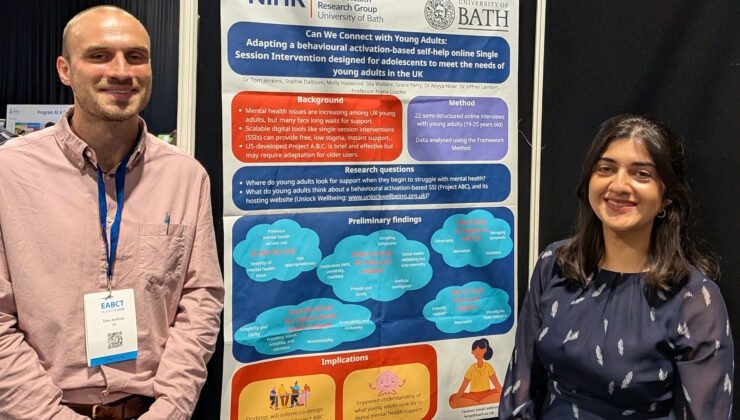
Dr Tom Jenkins and Dr Atiyya Nisar are pictured presenting work on single session digital interventions.
Read more